
Cost of Timber Cladding Melbourne: 2026 Pricing and Installation Guide
A cheap timber cladding quote is usually the most expensive one you'll ever sign. It's a common frustration for homeowners to sit at the kitchen table with three different quotes that don't seem to speak the same language. When you're trying to pin down the cost of timber cladding Melbourne residents often find themselves staring at a pile of conflicting numbers and wondering if they're paying for quality or just a fancy ute. You want a home that looks sharp and stays weather-tight, not a mounting list of maintenance chores and repair bills.
We believe you deserve clear, honest information to make a solid decision for your property. This guide offers a fair dinkum breakdown of what goes into a professional project in 2026, from selecting durable species like Spotted Gum to the expert installation secrets that prevent rot. We will walk through how material grades, current Victorian market trends, and skilled labour impact the final result, giving you the confidence to find a carpenter who values precision over a quick turnaround.
Key Takeaways
Learn how selecting the right species, like Spotted Gum or Silvertop Ash, balances upfront material costs with the durability needed for the Victorian climate.
Discover how to calculate the total cost of timber cladding Melbourne projects require by accounting for both material m2 rates and the value of expert labour.
Identify the essential "hidden" preparation steps, including sarking and structural battens, that protect your home from dampness and rot.
Understand why a precision-led installation from a master carpenter reduces long-term maintenance expenses and prevents expensive structural failures.
Table of Contents
Factors Influencing Timber Cladding Costs in Melbourne
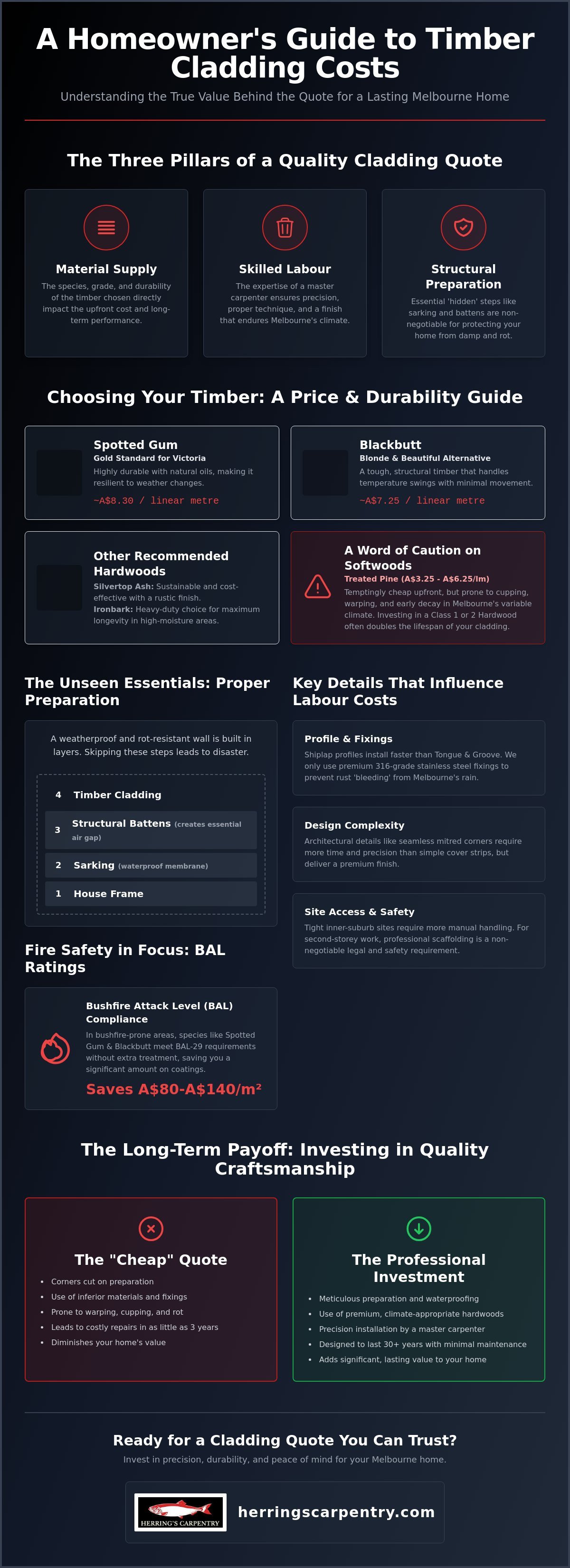
When you look at a quote for timber work, it's easy to get tunnel vision on the price of the boards themselves. The reality is that the cost of timber cladding Melbourne homeowners pay is a three-way split between material supply, skilled labour, and structural preparation. Getting this balance right is what ensures the job lasts thirty years instead of three. If one of these components is suspiciously cheap, you can bet the others will suffer.
The specific profile you choose also dictates the pace of the build. Shiplap profiles are generally quicker to install than traditional Tongue and Groove, which can be fiddly to align perfectly on older, slightly out-of-plumb Melbourne homes. Faster installation naturally keeps labour costs down. However, our local climate demands we don't cut corners on fixings. Because we often see "four seasons in one day," the timber constantly expands and contracts. We use premium 316-grade stainless steel fixings to prevent the "bleeding" and rust spots that occur with cheaper galvanised nails when the Melbourne rain hits. In the world of Cladding, these small details determine whether your facade stays beautiful or starts looking shabby within a few seasons.
Project Scope and Design Complexity
A simple feature wall in a backyard is a straightforward task. Wrapping a full double-storey facade is a different beast entirely. Every window, door, and external corner adds "cutting and scribing" time to the tradie's schedule. If you want architectural details like mitred corners, where the boards meet perfectly at a 45-degree angle, it requires a high level of precision. It is a slower process than using simple cover strips, but the seamless finish is worth the extra investment for a premium look.
Site Access and Scaffolding
Melbourne's inner suburbs, like Northcote or Seddon, often feature tight blocks with very little side access. If we have to hand-carry every length of Spotted Gum down a narrow side-way or through the house, the extra time will reflect in the labour quote. Safety is another non-negotiable factor. Victorian regulations are clear about working at height. If your project involves a second storey, professional scaffolding is a legal requirement. This is a fixed cost that ensures the job is done safely and correctly, protecting both the workers and your property.
Choosing Your Species: Material Price Breakdown
The species you select is the biggest variable in the cost of timber cladding Melbourne projects. It isn't just about the colour or the grain pattern. You're paying for durability and how well that timber stands up to the Victorian sun and the damp winters. In our experience, choosing a species that isn't suited to our local humidity is a recipe for warped boards and early rot.
Spotted Gum is often considered the gold standard for Victorian homes. It's a dense hardwood with a high natural oil content, making it incredibly resilient. According to 2026 market data, you can expect to pay around A$8.30 per linear metre for Spotted Gum. If you prefer a lighter, more blonde palette, Blackbutt is an excellent alternative at approximately A$7.25 per linear metre. Both are tough, structural timbers that handle our temperature swings without excessive movement. For those in Melbourne's outer suburbs looking for a sustainable, cost-effective hardwood, Silvertop Ash provides a beautiful, slightly more rustic finish that matches the Australian landscape perfectly. If your priority is maximum longevity in high-moisture areas, Ironbark is the heavy-duty choice, though its density makes it slower to work with on-site.
Hardwood vs. Softwood: The Long-Term Value
Softwoods like treated pine are tempting because the upfront price is low. You might find tight knot pine as low as A$3.25 to A$6.25 per linear metre. However, softwoods are prone to cupping and warping in Melbourne's variable climate. We generally recommend Class 1 or Class 2 durability hardwoods for exterior work. These timbers have a higher natural resistance to decay and termites. If you're planning a project involving cladding and feature walls, investing in a Class 1 hardwood usually pays for itself by doubling the lifespan of the installation.
BAL Ratings and Fire Safety Costs
If you live in a leafy suburb or a bushfire-prone area, your choice is often dictated by law. The Victorian Building Authority (VBA) enforces strict Bushfire Attack Level (BAL) ratings. Naturally bushfire-resistant species like Spotted Gum and Blackbutt are compliant for use in areas up to BAL-29 without extra treatment. This can save you a significant amount on fire-retardant coatings, which can add A$80 to A$140 per square metre to your costs. For more details on how material choice affects performance, check out this Australian government guide to cladding systems. Choosing a naturally compliant timber is usually the smartest way to manage your budget while staying safe.
Labour and Installation Costs: What to Expect from a Melbourne Tradie
Understanding the labour component of the cost of timber cladding Melbourne homeowners face is about more than just an hourly rate. Most people get caught up comparing quotes that look similar on paper but differ wildly in the quality of the finished structure. In the carpentry trade, you generally see two ways of pricing: a flat square metre (m2) rate or an hourly charge. While an m2 rate provides a clear total for your budget, an hourly rate is often used for complex renovations where we might find surprises behind your old weatherboards that need fixing before the new cladding goes on.
A master carpenter with decades of experience doesn't just nail boards to a wall. They work with an efficiency that a cut-price handyman can't match, ensuring every join is tight and every board is level. This precision prevents the gaps and leaks that lead to structural rot five years down the line. You also need to factor in the final finishing stage. Whether you choose a factory-applied finish or have your carpenter apply a high-quality oil like Cutek on-site, this step is vital. It protects the timber from the harsh Victorian sun and prevents the boards from silvering off prematurely if you want to keep that rich, natural hardwood look.
The Cost of Craftsmanship
When you pay for professional installation, you're investing in waterproofing knowledge and structural integrity. A seasoned pro knows exactly how to flash around windows and doors to keep the Melbourne rain out. This level of detail isn't just about aesthetics; it significantly impacts your home's resale value. Buyers in the Melbourne market can spot a DIY or cheap cladding job from the kerb. Avoiding the cheap quote trap ensures your home remains a solid asset rather than a liability prone to moisture damage.
Secret Fixing vs. Traditional Face Fixing
The method used to attach your cladding changes both the look and the labour time.
Secret Fixing: This involves driving nails or screws through the tongue of the board so they are hidden by the next overlapping piece. It creates a clean, fastener-free architectural look but takes longer to align perfectly.
Face Fixing: This is the traditional method where fixings are visible on the surface. It is faster and more cost-effective, which is why it's common for standard weatherboard styles.
Regardless of the method, we always insist on 316-grade stainless steel fixings. If you're anywhere near the coast or even in the humid inner-city suburbs, stainless steel is the only way to prevent black streak marks and rust from ruining your timber facade.
The "Hidden" Costs of Preparation: Sarking, Battens, and Waterproofing
A lot of quotes gloss over the prep work because it is hard to see once the boards are nailed on. But when you are calculating the cost of timber cladding Melbourne homeowners need to account for what happens behind the scenes. If your existing framing is out of plumb or has bowed over time, we have to spend time straightening those walls. Putting straight boards on a wonky frame is a waste of good timber. It will look wavy from the street and create gaps where moisture can settle.
Waterproofing is another area where a cheap quote can hide a lot of future trouble. Every corner, window, and door opening requires custom-folded metal flashing to redirect water away from your structural studs. Even the most expensive Spotted Gum will fail if the waterproofing is handled poorly. These preparation steps ensure that your investment is protected from the ground up, rather than just looking good for the first six months.
Moisture Management: Don’t Skimp on Sarking
Sarking is a breathable vapour barrier that sits directly behind your cladding. In Melbourne, we experience significant temperature swings that cause condensation to build up inside wall cavities. A high-quality, breathable sarking allows this internal moisture to escape while blocking external rain. Skipping this step or using a non-breathable alternative leads to condensation trapped in your insulation. This eventually rots your timber framing and creates a breeding ground for internal mould, which is a far more expensive problem to fix than the initial cost of the barrier.
Battening for Airflow and Longevity
We install a battening system to create what we call a "breathtaking" cavity. These vertical timber or metal battens create a 20mm gap between the sarking and the cladding boards. This gap allows air to circulate freely and any moisture that gets behind the timber to drain away. By equalising the moisture levels on both the front and back of the board, we prevent the timber from "cupping" or bowing as it seasons in the Victorian sun. We also integrate insect mesh at the top and bottom of these cavities to keep spiders and wasps out of your walls while maintaining that vital airflow.
If you're tackling a complex project or an older home, we provide comprehensive renovation support and fit‑outs to make sure your home's structure is prepared correctly from day one. Doing this work properly is the only way to ensure the total cost of timber cladding Melbourne remains a one-time investment rather than a recurring repair bill.
Why Investing in Professional Installation Saves You Money Long-Term
Thinking about the cost of timber cladding Melbourne projects require means looking well beyond the initial invoice. A cheap job might look acceptable for the first summer, but the true price reveals itself when the first heavy Victorian rains hit. We often see homeowners tempted by a $5,000 "handyman" fix over a $10,000 expert installation. By the second or third year, those cheap boards often cup, leak, or rot. The resulting repair bills and structural remediation usually far exceed the original savings you thought you made.
Professional installation is about making sure the timber stays where it belongs for decades. When we select a species like Spotted Gum and apply a professional-grade oiling system, we are setting you up for a much lighter maintenance schedule. It is significantly easier and cheaper to maintain a well-installed wall than it is to fix a structural failure caused by poor drainage. We also ensure your new facade ties in perfectly with other outdoor landscaping structures, creating a cohesive look across your entire property that adds genuine value to your home.
The Real Price of a "Cheap" Quote
Shortcuts are unfortunately common in low-cost quotes. We see installers skipping vapour barriers or using inferior fixings just to save a few hundred dollars on materials. These decisions lead to warped boards and water ingress that can eventually destroy your home's internal framing. Shane Herrings is still "on the tools" for every project, bringing decades of expertise to ensure these common mistakes don't happen on your watch. We are frequently called in to fix cladding jobs that are barely two years old because the original installer didn't understand how Australian hardwoods react to Melbourne's humidity.
Getting a Fair Quote from Herrings Carpentry
Our approach is straightforward. We provide honest advice and no-nonsense pricing that reflects the actual work required to do the job right the first time. We manage the entire process for you, from checking the integrity of your framing to applying that final, protective coat of oil. You won't find flashy sales tactics here; just a commitment to high standards and a respect for your property. Professional cladding is the perfect blend of structural weatherproofing and architectural beauty.
Secure Your Home with a Master Craftsman’s Finish
Choosing to reclad your home is a major investment that goes far beyond a fresh look. As we have discussed, the true cost of timber cladding Melbourne residents should plan for includes selecting high-grade Australian hardwoods and ensuring the structural preparation is flawless. Skipping the vapour barriers or choosing an unsuitable species might save a few dollars today, but it almost always leads to expensive repairs down the track. A quality installation is a shield for your home, protecting it from the unpredictable Victorian weather while significantly boosting its street appeal.
At Herrings Carpentry, we bring 30 years of local experience to every project. Our team consists of licensed and fully insured Victorian tradesmen who specialise in Australian hardwood finishes. We don't believe in flashy sales talk; we just believe in getting the job done right with honest, straightforward pricing. Get a fair dinkum quote for your Melbourne cladding project from Herrings Carpentry and let's build something that stands the test of time. Your home deserves a finish that is as durable as it is beautiful.
Frequently Asked Questions
Do I need a building permit for timber cladding in Melbourne?
Yes, you generally need a building permit for recladding projects in Victoria. All building work must comply with the National Construction Code (NCC) and Victorian Building Authority standards. For a full recladding project, it's wise to budget between A$5,000 and A$10,000 for the necessary building approvals and permits to ensure your project is legal and safe.
How often does timber cladding need to be oiled in the Victorian climate?
You should plan to oil your cladding every 12 to 24 months depending on how much sun the wall receives. Melbourne's high UV levels and frequent temperature swings can dry out hardwood quickly. Applying a high-quality oil helps maintain the timber's natural flexibility and prevents it from silvering off or developing surface cracks prematurely.
Can I install timber cladding directly over my existing brick walls?
No, you cannot nail timber cladding directly onto a brick surface. We must first install a system of timber or metal battens to create a flat, plumb surface and a vital air gap. This cavity is essential because it allows the wall to breathe and prevents moisture from being trapped between the brickwork and your new timber facade.
What is the most cost-effective timber species for a feature wall?
Silvertop Ash is often the most cost-effective hardwood for a feature wall in the Melbourne market. It provides a beautiful, durable finish at a lower price point than premium species like Spotted Gum. While treated pine is the cheapest material available, it is more prone to movement and requires more frequent maintenance to keep it looking sharp.
How much does timber cladding installation cost per square metre in Melbourne?
The total cost of timber cladding Melbourne homeowners pay for hardwood materials typically ranges from A$110 to A$350 per square metre. Installation labour can start as low as A$50 per square metre for very simple, ground-level jobs. However, this rate increases based on the complexity of the design, site access, and whether scaffolding is required for multi-storey work.
Is vertical cladding more expensive to install than horizontal weatherboards?
Vertical cladding is generally more expensive to install because it requires a specific horizontal battening system to support the boards correctly. This adds both extra material costs and more labour time compared to traditional horizontal weatherboards. Many people find the modern, architectural look of vertical boards is worth the slight premium in the project budget.
What happens if water gets behind my timber cladding boards?
If your cladding is installed correctly, any water that gets behind the boards will run down the breathable sarking and exit through the drainage cavity at the bottom. This is why we never skip the vapour barrier or the battening process. Without this drainage system, trapped moisture will quickly rot your structural wall framing and lead to expensive mould issues inside the home.
Can I use decking boards for my wall cladding to save money?
We don't recommend using decking boards for wall cladding. Decking lacks the shiplap or tongue-and-groove profiles designed to interlock and shed water effectively on a vertical surface. While it might look like a way to save money, it won't provide the weather-tight seal your home needs to stay dry during a heavy Melbourne downpour.


Comments