
Timber vs Composite Decking in Melbourne: A Professional Builder’s Guide
- Shane Herring
- Jun 26
- 12 min read
The most expensive deck you'll ever build is the one you have to rip up after five years because it couldn't handle the local weather. When weighing up timber vs composite decking Melbourne homeowners often feel forced to choose between the classic look of hardwood and the "set and forget" promise of modern composites. It's a big decision, especially when you consider how our extreme UV cycles and sudden downpours can turn a beautiful outdoor space into a warped, grey mess if the wrong material is used.
I know you'd rather spend your weekends firing up the barbecue than kneeling on the ground with a sander and a tin of oil. This guide shares my professional perspective on which materials actually stand up to the sun and which ones might get too hot for the kids to walk on in mid-January. You'll discover how to calculate the total cost of ownership beyond the initial build and how to ensure your choice fits your suburb's specific BAL rating. We're looking at the honest facts so you can build a deck that stays solid and looks great well into the future.
Table of Contents
The Melbourne Decking Dilemma: Timber or Composite?
Deciding on a new outdoor space usually starts with a simple question: do you want the real thing or the modern alternative? When comparing timber vs composite decking Melbourne builders often see homeowners struggle because both options have evolved significantly. Timber is the traditional choice, consisting of natural hardwoods like Merbau, Spotted Gum, or Ironbark. These are dense, durable timbers that have defined Australian backyards for decades. On the other hand, Wood-plastic composites (WPCs) are engineered products made from a blend of recycled plastic and wood fibres.
The dilemma in Melbourne is driven by our "four seasons in one day" reputation. One afternoon it's 38 degrees and baking; the next morning it's pouring rain. This constant cycling puts immense stress on any material. While a deck's look is usually what grabs your attention first, the best choice actually depends on your specific use case. Are you building a small balcony in Richmond, a sprawling poolside area in Brighton, or a deck in a high-fire-risk zone? Understanding the Total Cost of Ownership (TCO) over a 10-year period is vital. Timber might save you money on day one, but the cost of oil, cleaners, and your own time adds up quickly.
The Appeal of Traditional Australian Hardwoods
There is a reason why Spotted Gum and Merbau remain the gold standard for many local projects. You simply cannot replicate the tactile feel of real wood. The natural grain patterns, the unique colour variations of every board, and even that distinct timber scent create a warmth that man-made materials struggle to match. Hardwoods are also incredibly sturdy. If you choose sustainably sourced timber, you're using a renewable resource that stores carbon. For a traditional Victorian or Federation home, nothing looks quite as right as a well-maintained hardwood deck.
The Rise of High-Performance Composite Boards
Composite technology has come a long way from the early "plastic-looking" boards of twenty years ago. Modern capped composites feature a protective outer layer that resists staining and fading. The biggest drawcard for Melbourne families is the lack of maintenance. You won't be spending your long weekends sanding back grey boards or applying coats of oil. These boards don't splinter, which is a major safety win for kids and pets. In modern architectural builds across the inner suburbs, the clean lines and consistent colour of composite decking provide a sleek, contemporary finish that requires nothing more than an occasional wash with soapy water.
Comparing Performance in the Melbourne Climate
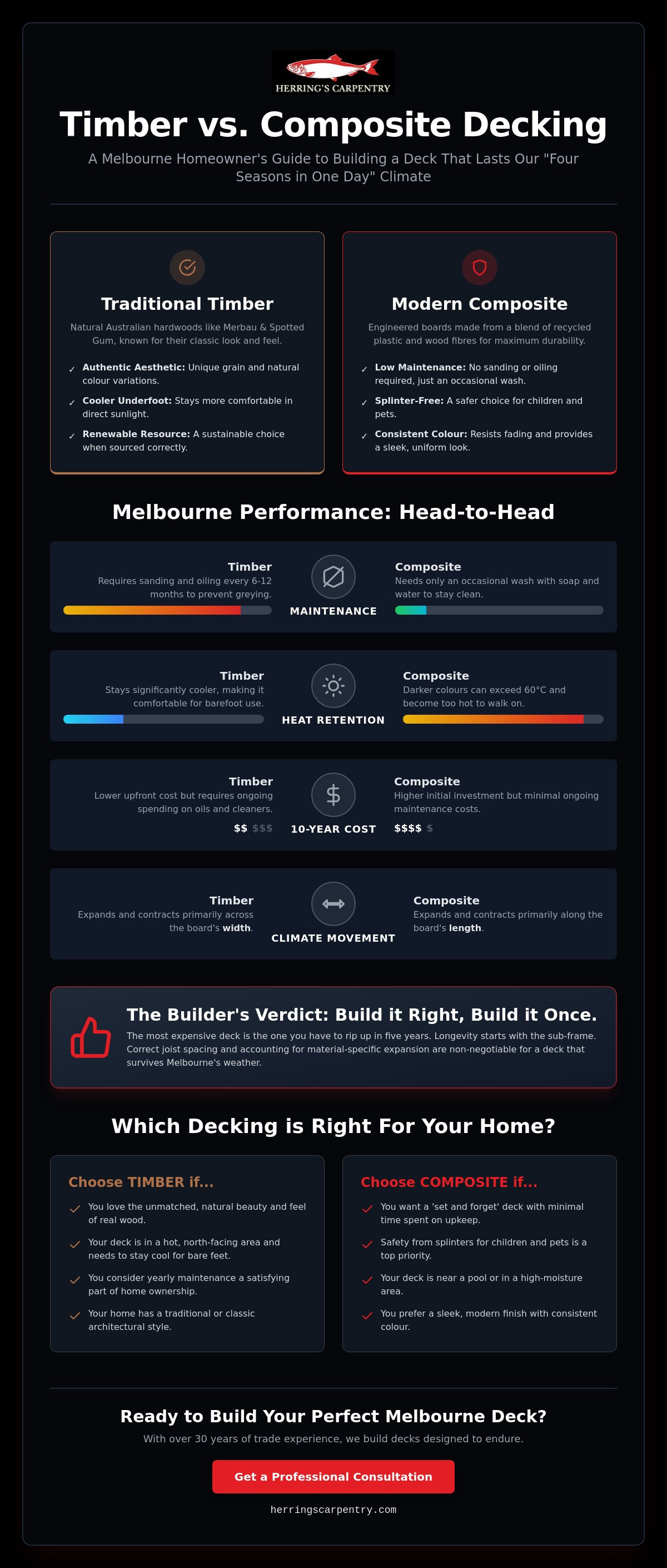
Melbourne’s weather is notoriously unpredictable. Our "four seasons in one day" isn't just a local saying; it's a genuine engineering challenge for outdoor structures. When choosing between timber vs composite decking Melbourne homeowners must consider how materials react to rapid temperature swings. Timber tends to expand and contract across its width. Composite boards, however, expand and contract along their length. If your builder doesn't account for these specific movements during installation, you'll end up with buckled boards or sheared screws before the first year is out.
The UV index in Victoria is another major factor. The Australian sun is brutal on any surface. Natural timber will inevitably "silver off" or turn grey if it isn't oiled every six to twelve months. While composite decking is often marketed as fade-resistant, it isn't completely immune to the sun. High-quality boards contain UV inhibitors that slow the process down significantly. Recent sustainable composite decking research highlights how new manufacturing techniques are improving the environmental resilience of these materials. Even with these advancements, a "low maintenance" composite deck still requires a regular wash with soapy water to prevent mould and tannin stains from settling into the grain.
Thermal Comfort: The Barefoot Test
Heat retention is where timber usually takes the lead. On a typical 35-degree Melbourne afternoon, a dark composite deck can reach surface temperatures exceeding 60 degrees. That is hot enough to be uncomfortable for kids or pets. In contrast, natural hardwoods like Spotted Gum stay significantly cooler underfoot. If your backyard is north-facing with no shade, timber is often the more practical choice for barefoot comfort. If you're set on composite, I always recommend choosing the lightest colour possible to help reflect the heat rather than absorbing it like a radiator.
Fire Safety and BAL Ratings in Melbourne
If you live in the outer suburbs or near a bushy reserve, your deck must comply with specific Bushfire Attack Level (BAL) ratings. This is a non-negotiable safety requirement. Certain Australian hardwoods, such as Silvertop Ash and Spotted Gum, are naturally fire-resistant and suitable for areas rated up to BAL-29. Composite options vary wildly in this department. Some entry-level boards have no formal fire rating, while premium brands offer products specifically engineered for BAL-12.5 to BAL-29 zones. Before you buy any materials, check your property’s overlay. If you need a hand navigating these regulations for your decking and pergola project, it's worth getting professional advice early in the planning stage.
Cost Analysis: Upfront Price vs Long-Term Value
When you look at the price tags at the local timber yard, the gap between timber vs composite decking Melbourne is obvious. Standard hardwood boards are generally the more affordable entry point. In contrast, high-end composite boards can be 30% to 50% more expensive to purchase upfront. However, as a builder, I always tell my clients that the purchase price is only the first chapter of the story. You have to look at the total life of the structure to understand which one is actually the better deal.
A well-built hardwood deck typically has a lifespan of 15 to 20 years, provided it's looked after properly. Modern composites are often warrantied for 25 years or more. If you plan on staying in your home for the next decade, that upfront premium for composite starts to look like a smart hedge against future labour and material costs. Over 10 years, the money you spend on maintenance for a timber deck can often bridge the price gap entirely.
The Hidden Costs of DIY Timber Maintenance
Let's look at the numbers for a standard 20sqm backyard deck. To keep timber looking its best in Melbourne, you need to clean and oil it at least once a year. A decent tin of decking oil, high-quality brushes, and specialised deck cleaners will set you back a couple of hundred dollars every time. Then there is your time. It takes a full weekend to prep, scrub, and apply two coats of oil. If you value your time at even a modest hourly rate, or if you pay a professional to do it every two years, the "cheap" timber option becomes a significant ongoing expense.
Resale Value and Aesthetic Longevity
Property buyers in Melbourne are increasingly savvy about maintenance. A pristine composite deck is often viewed as an asset because it represents zero work for the new owner. It looks exactly the same on open-inspection day as it did five years ago. That said, a hardwood deck Melbourne still holds a special place in premium renovations. Some homeowners actually prefer the natural "grey look" that comes from silvering timber, which requires less frequent oiling but still offers that authentic, organic feel that many high-end buyers crave. It comes down to whether you want a deck that stays "new" or one that ages with character.
How to Build for Longevity: The Builder’s Perspective
The best boards in the world won't save a deck built on a flimsy skeleton. When planning your decking ideas Melbourne project, the sub-frame is where your budget and attention should focus first. A common mistake I see is using the same structural logic for both materials. When comparing timber vs composite decking Melbourne builders know that the spacing of your joists is non-negotiable. For a standard 19mm hardwood board, 450mm centres are the industry standard. However, composite boards are more flexible and lack the natural rigidity of wood. Most composite manufacturers specify a maximum joist spacing of 350mm to 400mm. If you ignore this, your deck will bounce when you walk on it and eventually sag under its own weight.
Ventilation is another deal-breaker. Melbourne's clay-heavy soil holds moisture like a sponge. If you're building a deck low to the ground, you need adequate clearance and proper cross-flow ventilation. Without it, the underside of your boards will rot or warp while the top looks perfectly fine. For these low-clearance builds, we often use specific H4 treated timber or even steel sub-frames to handle the damp conditions. Proper drainage under the deck is just as important as the boards on top.
Step 1: Preparing the Sub-Frame
We always use H3 or H4 treated pine for our bearers and joists to protect against rot and termites in the local soil. To go the extra mile, apply joist protection tape to the top of every timber member. This prevents water from sitting in the screw holes and rotting the frame from the inside out. It's a small expense during the build phase that adds years of life to the structure. If you want a deck that stays level for decades, you can't skip these small details in the framing stage.
Step 2: Managing Expansion and Gapping
Timber and composite move in completely different ways. Hardwood boards need a 3mm to 5mm gap between them primarily for drainage and airflow. Composite boards, however, expand and contract along their length as the temperature changes. This means you need specific gaps at the ends of the boards, often requiring "double-joisting" where two boards meet end-to-end. This ensures each board end is fully supported on its own joist rather than sharing one. If you’re ready to start your project, our team provides expert decking and pergola installations that follow these exact structural standards to ensure your investment lasts.
Final Verdict: Choosing the Right Deck for Your Home
There is no single "best" material when comparing timber vs composite decking Melbourne. The right choice depends on your property’s orientation, your architectural style, and how much time you want to spend on maintenance. Timber remains the superior choice for north-facing decks where thermal comfort is the priority. It offers a classic, tactile warmth that fits perfectly with traditional Melbourne homes. If you are budget-conscious at the start of the build and don't mind the annual ritual of oiling, hardwood is a reliable, high-performance option.
Composite decking is the ultimate solution for the "time-poor" homeowner. It is the logical pick for poolside areas where bare feet need protection from splinters and for modern builds that require a sleek, consistent finish. While the initial cost is higher, the trade-off is a deck that stays pristine for decades without you ever having to pick up a sander. It’s about deciding whether you value the organic character of aging wood or the effortless durability of an engineered product.
Why Local Expertise Matters
At Herrings Carpentry, we don't believe in a one-size-fits-all approach. We provide grounded, no-nonsense advice based on over 30 years of building in the local area. We treat every deck as a permanent structural extension of your home, not just an add-on. This means our framing is precise, our footings are deep, and our material recommendations are honest. Whether you want the rich grain of Spotted Gum or the low-maintenance ease of a high-end composite, we ensure the underlying structure is built to last. You can explore our custom outdoor living options through our deck and pergola packages Melbourne.
Next Steps: Planning Your Build
The first step in any successful project is a thorough site assessment. We organise site visits to inspect your ground levels, check for proper drainage, and discuss your specific BAL rating requirements. We’ll help you select the right board width and colour palette to complement your existing house. If you’re looking for a builder who values integrity and straightforward communication, contact Shane and the team today. We’ll give you an honest appraisal of your site and help you pick the material that delivers the best long-term value for your backyard.
Build Your Ideal Melbourne Outdoor Space
Choosing the right material isn't about finding a single winner; it's about finding the best fit for your backyard and your lifestyle. Whether you prefer the organic warmth of hardwood or the low-maintenance promise of high-end boards, the outcome depends on the integrity of the build. A deck is only as good as the sub-frame supporting it, and getting those structural details right is what ensures your investment survives the local climate. When you weigh up timber vs composite decking Melbourne, remember to look past the initial price tag to the decade of use ahead.
Herrings Carpentry is a family-owned and operated business led by Shane Herring, a licensed carpenter with over 30 years of local experience. We are specialists in custom outdoor living and structural framing, bringing a no-nonsense approach to every project we take on. We don't believe in shortcuts; we believe in doing the job right the first time so you can enjoy your outdoor space without worry.
Get a straightforward quote for your Melbourne deck from Herrings Carpentry. We look forward to helping you create a durable, beautiful space that adds genuine value to your home.
Frequently Asked Questions
Does composite decking get too hot for dogs in Melbourne?
Yes, dark-coloured composite boards can reach surface temperatures that are uncomfortable for paws during a typical 35-degree Melbourne afternoon. Because these boards are dense and often contain plastic, they retain heat longer than natural wood. If you have pets or young children, I recommend choosing lighter shades or ensuring the area is well-shaded. Timber remains the cooler option underfoot for north-facing backyards with direct sun exposure.
How often do I actually need to oil a timber deck in Victoria?
You should plan to oil your timber deck every 6 to 12 months to maintain its colour and structural integrity. Melbourne's high UV levels and rapid weather shifts mean that boards can dry out and silver off quickly. A deck that faces north or is fully exposed to the rain will usually need attention twice a year, while a covered deck might last 18 months between coats.
Can I install composite decking over my old timber deck frame?
You can only do this if the existing sub-frame is structurally sound and meets the tighter joist spacing requirements for composite materials. Most composite brands require joists to be spaced at 350mm to 400mm centres, whereas older timber decks often use 450mm spacing. When comparing timber vs composite decking Melbourne homeowners often find they need to add extra joists to prevent the more flexible composite boards from sagging over time.
Which decking material is best for a pool area in Melbourne?
Composite decking is generally the better choice for pool surrounds because it is splinter-free and highly resistant to rot and mould. It handles constant splashing and wet feet without the surface becoming as slippery as some oiled hardwoods. You won't have to worry about pool chemicals stripping the finish or tannins from the wood leaching into your pool water, making it a lower-maintenance option for busy families.
What is the best hardwood for a deck in Melbourne’s climate?
Merbau and Spotted Gum are the most reliable hardwoods for local conditions due to their high density and natural durability. Spotted Gum is a particular favourite because it is a native Australian timber with excellent fire-resistant properties, which is vital for many outer Melbourne suburbs. These species handle the "four seasons in one day" weather cycles better than softer timbers like treated pine, which tends to warp more easily.
Do I need a permit for a new deck in Melbourne?
A building permit is generally required in Victoria for any deck with a surface height of more than 800mm above the natural ground level. You might also need a planning permit depending on your local council's rules regarding property boundaries and overlooking neighbours. It's vital to check these regulations before you start, as a registered builder must be appointed for any project where the total cost exceeds $10,000.
Is composite decking really eco-friendly?
Most modern composite boards are considered eco-friendly because they are manufactured using recycled plastic and reclaimed wood fibres. This process keeps a significant amount of waste out of landfills. Because these decks don't require the chemical oils, stains, or cleaners used for timber maintenance over a 25-year lifespan, their long-term environmental footprint is often lower than that of traditional wood products that require frequent chemical treatments.
Can I pressure wash my composite or timber deck?
You can use a pressure washer on a low-pressure setting, but I generally advise against it because it's easy to damage the surface. High pressure can tear the fibres of a timber deck or leave permanent "scar" marks on composite boards. A much safer and more effective method is to use a stiff-bristled brush with a dedicated deck cleaning solution and a standard garden hose to shift any stubborn Melbourne grime.


Comments